


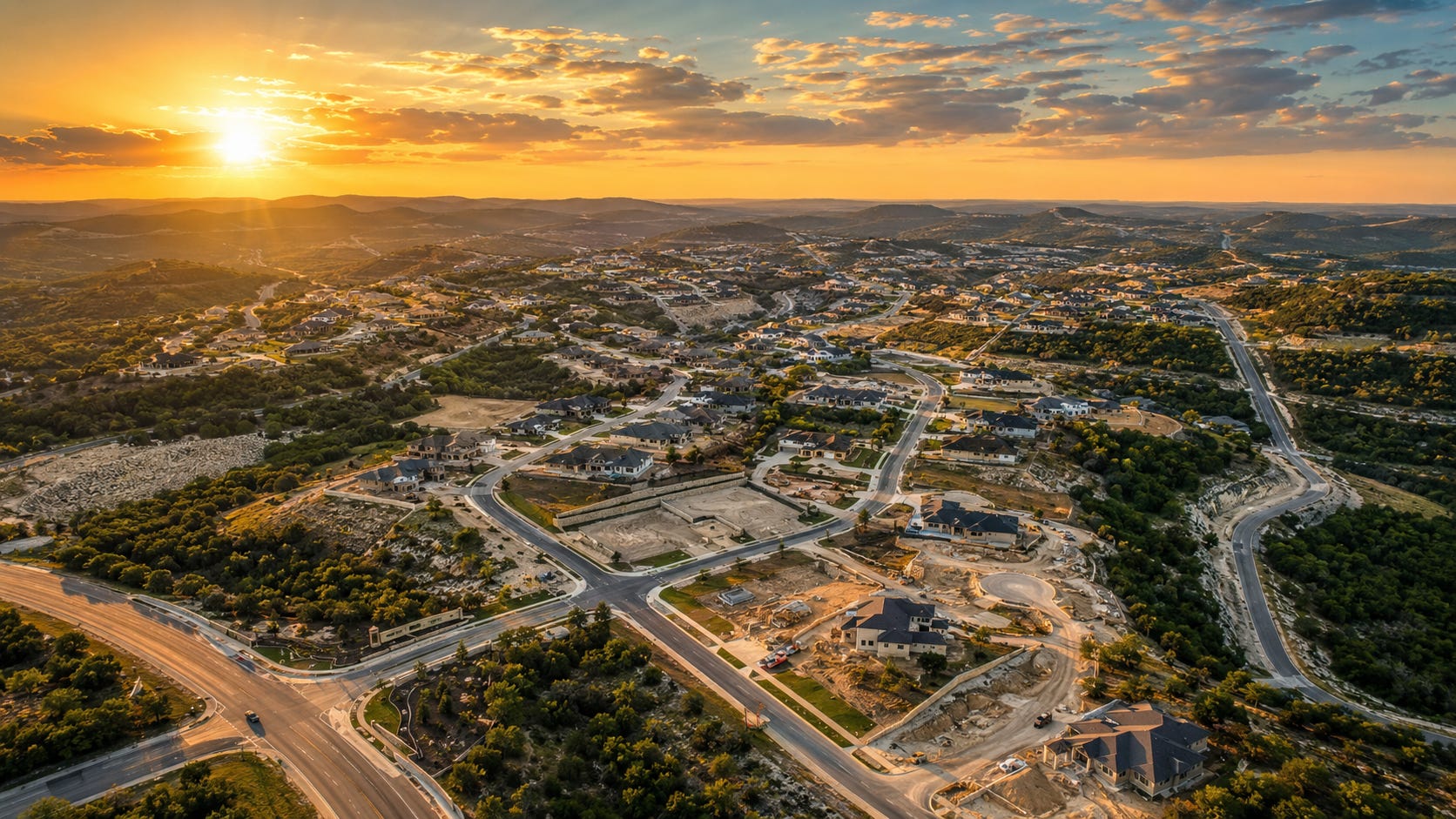
In most of America, a developer who wants to build a thousand homes on raw land faces an infrastructure problem with no clean solution. The water lines, sewer mains, drainage channels, and roads must exist before anyone moves in, and none of it generates revenue until it does. Cities will not fund it — they answer to existing voters who see no reason to finance infrastructure for people who have not arrived. Counties lack the bonding capacity. State and federal programs are too slow.
Texas looked at this problem and, starting in the 1960s, built a layered system of special-purpose districts that allows infrastructure to be financed, built, and paid for by the people who benefit from it, without requiring cities or counties to carry the risk. Over 2,500 special districts now operate in Texas. As of late 2025, Texas local governments carried $368.3 billion in outstanding debt. In the May 2025 election cycle alone, voters were asked to approve $41.3 billion in new principal across 313 propositions.
This is infrastructure at industrial scale. Most of the country does not understand how it works.
The Core Tools
Municipal Utility Districts (MUDs) are the foundational mechanism — independent political subdivisions with the power to issue bonds, levy taxes, and charge user fees. A developer builds infrastructure on raw land, then the MUD issues bonds to reimburse the developer once the TCEQ confirms the infrastructure is complete and a sufficient tax base exists. Bond proceeds repay the developer. Property taxes on homes and land within the district service the debt. Over 950 MUDs now operate in Texas, and every major master-planned community in the Houston metro area — The Woodlands, Clear Lake City, First Colony — was built using them.
The critical structural feature: developers do not get reimbursed until real value exists on the ground. This is reimbursement finance, not speculative finance. The developer takes construction risk. The bond market takes credit risk only after delivery.
Public Improvement Districts (PIDs) are created by cities under Chapter 372 of the Local Government Code. Unlike MUDs, PIDs are not independent governments — the municipality retains control, issues the debt, and administers the district. PID assessments are fixed, several (one owner’s default cannot increase another’s obligation), and can be prepaid. PIDs finance a broader range of improvements than MUDs: parks, trails, lighting, pedestrian infrastructure, affordable housing, and mass transit facilities. The tradeoff is administrative complexity and ongoing municipal oversight.
Tax Increment Reinvestment Zones (TIRZs) are the Texas version of tax increment financing. A municipality freezes the property tax base within a zone, then captures the incremental revenue generated by rising property values and reinvests it within the zone. TIRZs fund streetscaping, utilities, transit stations, and public facilities. They do not create new taxes — they redirect existing revenue. The risk is that the city foregoes increment revenue for decades, betting that the improvements will eventually produce a stronger tax base.
Water Control and Improvement Districts (WCIDs) are older cousins of MUDs with broader authority, including the power to purchase existing water facilities. Management Districts fund supplemental services — security, landscaping, marketing — for commercial areas.
What Makes It Work
Three structural features distinguish the Texas model.
First, infrastructure cost is allocated to the people who create the demand. MUD taxes and PID assessments are paid by property owners within the district, not the broader tax base. This eliminates the most powerful political barrier to growth: existing residents objecting that their taxes will subsidize newcomers.
Second, the system allows infrastructure to be built in advance of municipal capacity. Texas cities grew faster than their governments could accommodate. Special districts bypassed constitutional debt limits and political resistance by creating new, purpose-limited governments with their own tax base.
Third, phasing discipline is enforced. The TCEQ will not approve MUD bonds until infrastructure is complete and a tax base is established. The Attorney General must approve all MUD bonds. PID assessments require city council authorization. These sequential gates prevent bond issuance from running ahead of physical reality.
What the Rest of the Country Should Learn
Any state serious about housing production should study these tools and adopt the structural discipline while fixing the governance weaknesses.
Separate infrastructure finance from general municipal politics. Let beneficiaries fund their own infrastructure. This removes the political barrier to growth.
Use reimbursement structures, not speculative ones. Require infrastructure delivery before bond issuance. The discipline of building first is what makes the credit work.
Allow multiple tools for multiple problems. MUDs for utilities, PIDs for amenities under municipal control, TIRZs for redevelopment. One mechanism cannot serve every purpose.
Set hard timelines for governance transition. Developer control during formation is pragmatically necessary but must be time-limited.
Build transparency infrastructure before physical infrastructure. Texas passed HB 103 in 2025 creating a centralized bond transparency database. This reform should have come decades earlier — and should be a precondition, not an afterthought, in any state adopting these tools.
Pair finance tools with planning standards. The financing mechanism is agnostic about urban form. It will fund good places and bad ones with equal efficiency. Without design codes, connectivity requirements, and public space obligations, the system builds sprawl with better plumbing.
Texas solved the capital problem. But capital without governance is extraction. Infrastructure without planning is sprawl. The question for every other state is not whether to build the machine — it is whether to build the constraints before the machine starts running.