
Moving on Up
Toll Brothers acquires Buffington Homes and bets that Northwest Arkansas is no longer a secondary market.

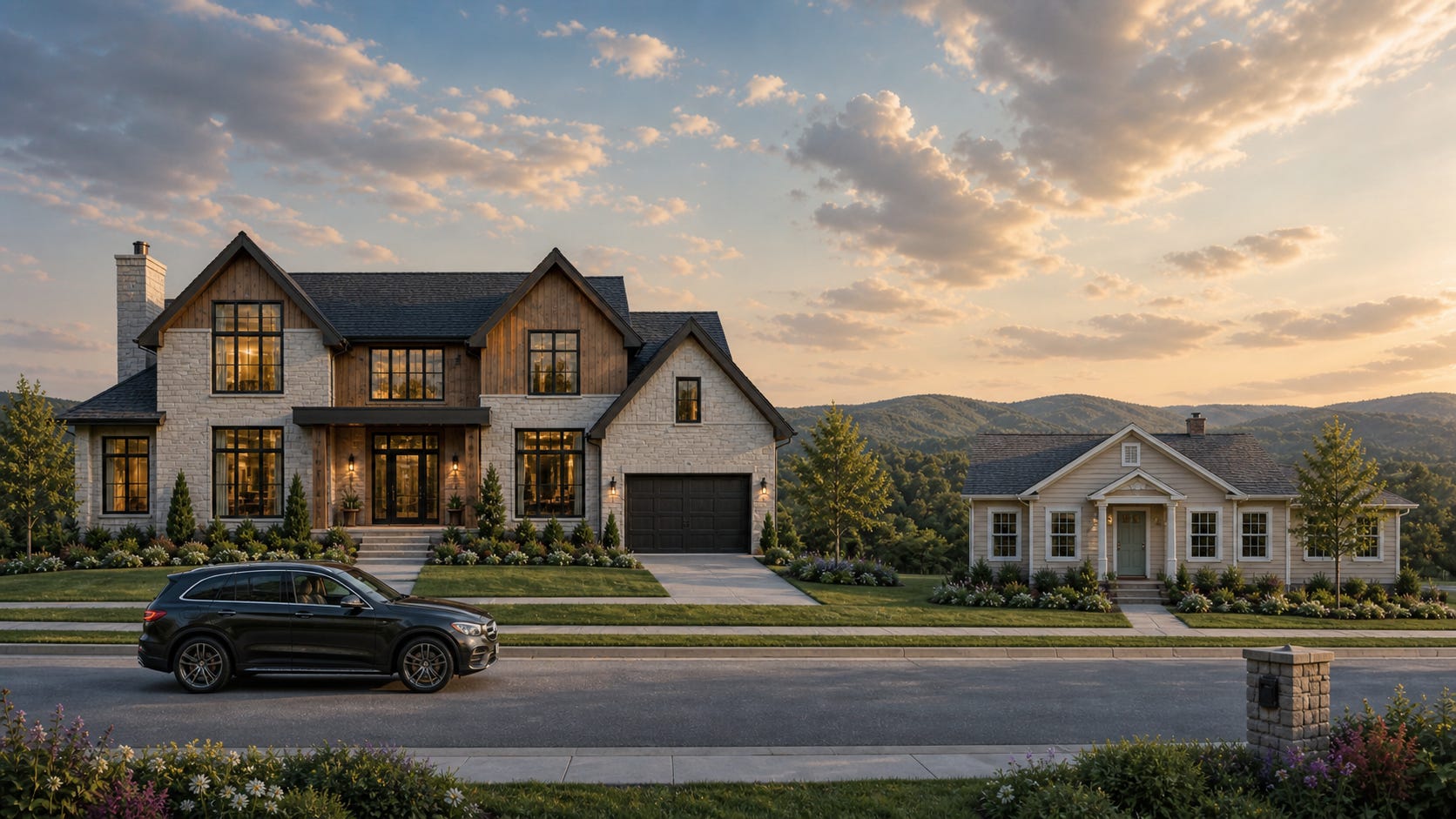
In April 2026, Toll Brothers signed a deal to acquire substantially all the assets of Buffington Homes of Arkansas, the largest luxury homebuilder in Northwest Arkansas. Buffington controls more than 1,500 lots across nine communities in the Fayetteville-Bentonville corridor, building first-time and move-up homes priced from $400,000 to over $1 million, with average selling prices around $650,000. Founding partners Clay Carlton and Mike Lamberth will stay on to lead land acquisition and development. This is Toll Brothers’ sixteenth homebuilder acquisition since 1995. Financial terms were not disclosed.
The deal is not surprising. What is surprising is that it took this long.
Northwest Arkansas has been quietly assembling the conditions that attract national capital for more than a decade. The metro has crossed 600,000 residents and adds roughly 250 new people per week. Three Fortune 500 companies — Walmart, Tyson Foods, and J.B. Hunt — anchor the economy, drawing nearly 1,300 suppliers and vendors to the region. Walmart’s new 350-acre mass-timber headquarters campus opened in Bentonville in 2025, housing 15,000 employees in twelve buildings designed into the city’s street grid, with the 40-mile Razorback Greenway running through the center. Home prices in Benton County averaged $471,427 as of late 2025, a 60.6% increase over five years. Residential building permits hit 3,000 in 2024, the highest since 2006.
Toll Brothers’ business model is built to exploit exactly this profile. The company serves move-up and empty-nester buyers — over 70% of its business — with a national average sale price near $976,000. Its buyers are less sensitive to mortgage rates than entry-level purchasers. They spend roughly $206,000 per home on design studio customizations, structural options, and lot premiums. CEO Karl Mistry has described the company’s strategy as entering markets where affluence is established or rising, partnering with strong local operators, and scaling from a position of alignment. Buffington’s $650,000 average sale price, strong margins, and local land position fit that playbook precisely. So does a region where area median income for a family of four recently crossed $101,800.
The question now is where the growth goes. The four core cities — Bentonville, Fayetteville, Rogers, and Springdale — are increasingly built out. Sixty-one percent of regional population growth is already occurring outside those cities. The next wave of residential development is pushing into western Benton County — Centerton, Cave Springs, Elm Springs, Tontitown, Highfill — where land is available but infrastructure is strained. Sewer capacity is a binding constraint; municipalities have spent years working to connect to the Northwest Arkansas Conservation Authority’s regional wastewater treatment plant. Highway 112 corridor improvements will link Fayetteville through Tontitown to Bentonville, opening new residential and commercial frontage. A proposed north-south connector between the Bella Vista Bypass and U.S. 412 could unlock large parcels near the regional airport in Highfill, one of the few communities with significant undeveloped land remaining in the county.
Toll Brothers’ entry accelerates a pattern already underway. With Buffington’s 1,500 controlled lots, an in-house architectural, engineering, mortgage, and land development operation, and the capital to acquire additional positions, Toll Brothers can move faster along these growth corridors than a privately held regional builder could alone. The retention of Carlton and Lamberth — the local operators who know which land to buy, how to phase, and which product fits which submarket — is the piece that makes the strategy executable rather than theoretical.
Whether Toll Brothers reshapes Northwest Arkansas or simply scales what Buffington already built will depend on what happens at the edges: whether the outlying towns can deliver infrastructure fast enough to support the lots, whether the region develops coordinated land-use policy across its patchwork of jurisdictions, and whether the design standards that have distinguished this metro — Crystal Bridges, the Greenway, Walmart’s campus — hold as production volume increases. The capital has arrived. The land position is secured. What remains to be built is the governance to match the growth.